AI Control Tower: The Missing Management Layer for Enterprise AI Agents
AI agents are no longer the hard part. Managing them safely, efficiently and at scale is.
Businesses are moving quickly from experimenting with individual AI tools to deploying AI agents across sales, customer service, finance, HR and operations.
One agent may qualify leads. Another may answer customer queries. A third may extract information from documents. Others may connect with CRMs, ERPs and internal systems.
Individually, these agents can create significant value.
But as their numbers grow, a new problem appears:
Who is managing the AI ecosystem?
Who knows what every agent is doing?
Who controls what each agent can access?
Who monitors failures and costs?
Who decides when an AI agent should involve a human?
And how can a business scale AI without creating a collection of disconnected automations?
This is where an AI Control Tower becomes increasingly important.
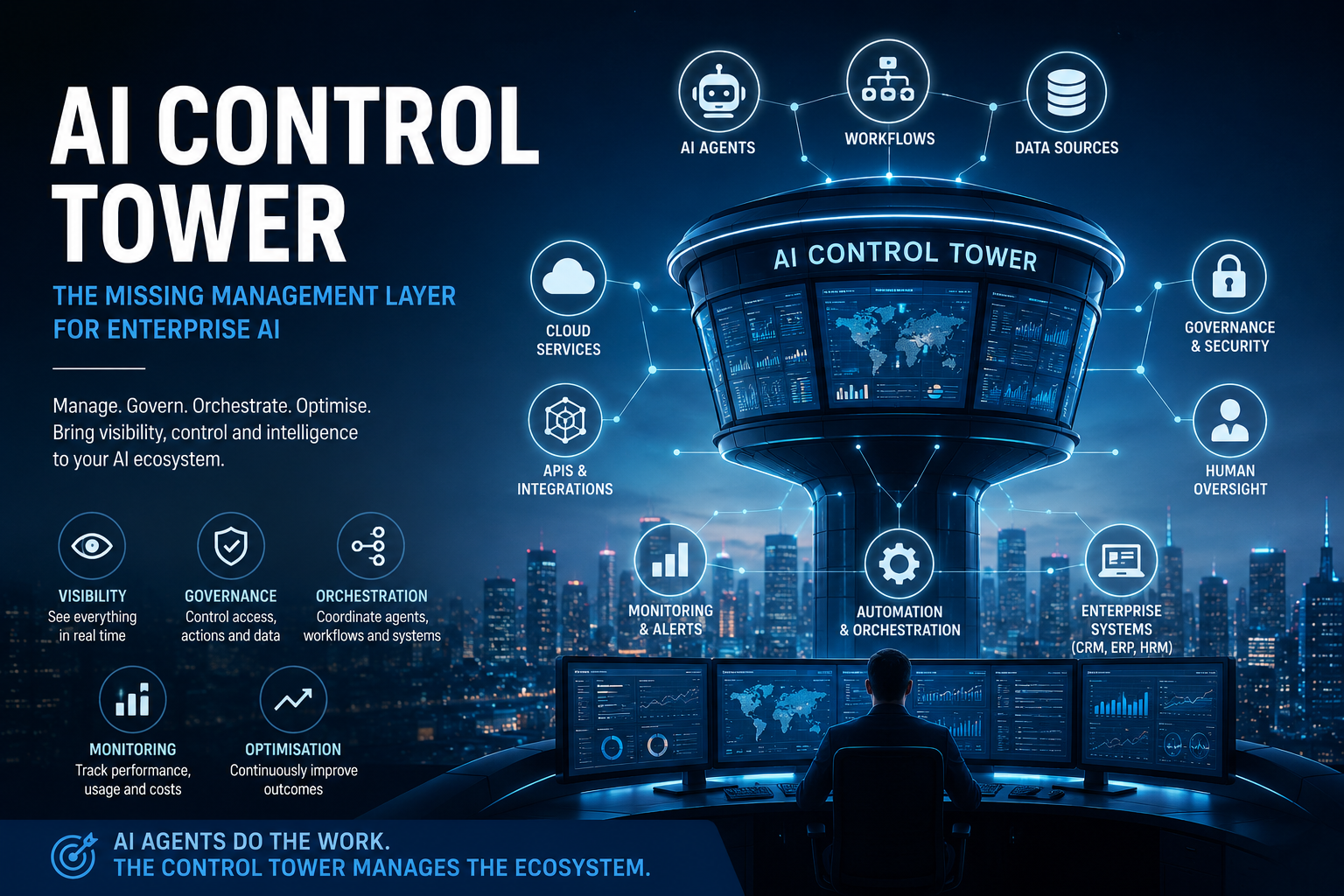
An AI Control Tower provides a central layer for visibility, governance, orchestration, monitoring and optimisation across an organisation’s AI ecosystem.
It is not simply another dashboard.
It is the management layer that helps businesses turn multiple AI capabilities into a controlled, connected and scalable AI operating environment.
What Is an AI Control Tower?
Think about an airport.
An airport may have dozens or hundreds of aircraft operating around it, but each aircraft doesn’t operate independently.
A control tower provides visibility and coordination. It helps manage traffic, communicate instructions, identify potential conflicts and ensure that operations follow defined rules.
An AI Control Tower follows a similar principle.
Instead of aircraft, the environment contains:
- AI agents
- Automation workflows
- AI models
- Business applications
- APIs
- CRM and ERP systems
- Data sources
- Human approval processes
The Control Tower provides a central layer to help the organisation understand and manage how these components interact.
In simple terms:
An AI agent does the work. An AI Control Tower helps the business manage how that work happens.
Why AI Agents Alone Aren’t Enough
Building an AI agent is becoming easier.
The difficult part is putting that agent into a real business environment.
Consider a company with six AI agents:
Sales Agent
Qualifies incoming leads.
Customer Service Agent
Answers customer questions.
HR Agent
Handles routine employee enquiries.
Finance Agent
Extracts information from invoices.
Operations Agent
Monitors workflows and triggers actions.
Knowledge Agent
Retrieves information from internal documents.
Everything seems fine while these systems operate independently.
But businesses don’t operate in isolation.
These agents may need to interact with the same:
- customer records
- employee data
- financial information
- CRM
- ERP
- documents
- APIs
- communication platforms
- business rules
Now the complexity changes.
What happens when one agent needs information from another?
What happens when two workflows trigger conflicting actions?
What happens when an agent wants to access sensitive data?
What happens when an AI recommendation needs human approval?
And what happens when an organisation has 50 or 100 AI agents instead of six?
This is where AI orchestration and governance become essential.
The Three Core Functions of an AI Control Tower
An effective AI Control Tower can be thought of through three fundamental capabilities:
1. Visibility — Know What Your AI Is Doing
You can’t manage what you can’t see.
Businesses need visibility across their AI ecosystem.
For example:
- Which AI agents are active?
- Which workflows are running?
- Which systems are being accessed?
- Which models are being used?
- How often are agents being triggered?
- Where are failures occurring?
- How long are workflows taking?
- What is each automation costing?
Without this visibility, AI can quickly become a collection of disconnected systems that are difficult to monitor.
An AI Control Tower brings these activities into a more centralised view.
2. Control — Decide What AI Is Allowed to Do
AI autonomy doesn’t mean unlimited access.
A business may want an AI sales agent to:
Read:
Customer and lead information.
Update:
Lead status and follow-up notes.
Trigger:
A follow-up workflow.
But it may not want that same agent to:
- change pricing
- approve discounts
- delete customer records
- issue refunds
- access sensitive financial information
The Control Tower can help establish these boundaries.
This creates an important distinction:
AI can perform an action doesn’t mean AI should be allowed to perform that action.
As AI agents become more capable of taking real-world actions, this distinction becomes increasingly important.
3. Optimisation — Make AI Work Better Over Time
AI automation shouldn’t be something a business builds and forgets.
It needs continuous improvement.
Businesses should be able to understand:
- Which agents are delivering measurable value?
- Which workflows are creating bottlenecks?
- Which processes still require unnecessary human intervention?
- Which models are too expensive for specific tasks?
- Where are agents failing?
- Which automations should be expanded?
- Which workflows should be redesigned?
This turns AI management into an ongoing business optimisation process.
The goal isn’t simply:
“We have AI.”
The goal is:
“Our AI is improving the way the business operates.”
AI Agent vs AI Control Tower
The difference is easier to understand when placed side by side.
| AI Agent | AI Control Tower |
| Performs a specific task | Oversees the AI ecosystem |
| Executes actions | Governs actions |
| Uses tools and data | Controls access to tools and data |
| Operates within a defined role | Coordinates multiple AI capabilities |
| Produces outputs | Monitors performance and outcomes |
| Focuses on execution | Focuses on visibility and control |
| Works at task level | Works at ecosystem level |
In simple terms:
The agent is the worker.
The Control Tower is the management layer.
Where Does AI Orchestration Fit?
AI orchestration is another critical part of this architecture.
Imagine a customer submits a request.
The workflow could look like this:
Customer Request
↓
AI Agent understands the request
↓
CRM retrieves customer information
↓
Specialised AI Agent analyses the issue
↓
Business rules are checked
↓
ERP action is triggered
↓
Human approval if required
↓
Customer receives a response
↓
Interaction is logged
That is not simply an AI-agent problem.
It is an orchestration problem.
The orchestration layer helps determine:
What happens next?
The Control Tower adds another question:
Can it happen, under what rules, and can we see what happened?
Together, they help create a more controlled AI operating environment.
Governance Becomes Critical as AI Becomes More Autonomous
For businesses, AI governance isn’t simply about compliance.
It is about maintaining control as automation becomes more capable.
Consider a few scenarios.
Customer Data
Can an AI agent access customer records?
Financial Information
Can it view invoices?
Can it initiate a financial transaction?
Employee Information
Can an HR agent access sensitive employee records?
External Communication
Can an AI agent send an email without approval?
Commercial Decisions
Can an AI system change a quote or discount?
Operational Actions
Can an agent update an ERP record automatically?
These questions cannot always be solved with a better prompt.
They require a combination of:
Permissions + policies + workflows + monitoring + human oversight
That is why governance needs to be considered as part of the architecture—not added after the AI system is already deployed.
The Rise of AI Sprawl
There is another challenge businesses need to consider.
It isn’t just AI adoption.
It is AI sprawl.
Sales may adopt one AI platform.
Marketing uses another.
HR builds an AI assistant.
Operations creates workflow automations.
Finance introduces document-processing AI.
Developers build custom agents.
Before long, the organisation has dozens of AI capabilities operating across different platforms.
Each solution may work.
But the overall ecosystem can become difficult to manage.
This creates questions such as:
- Where is AI being used?
- Who owns each agent?
- What data can each agent access?
- Which systems are connected?
- Which AI models are being used?
- What happens when an agent fails?
- Are multiple teams solving the same problem?
- What is the total AI cost?
An AI Control Tower can help businesses move from AI sprawl to an AI operating model.
From AI Tools to an AI Operating Model
The conversation around enterprise AI is changing.
Initially, businesses asked:
“Which AI tool should we use?”
Then:
“What can we automate with AI?”
The next question should be:
“How do we operate AI across the business?”
That requires thinking beyond individual tools.
A scalable AI environment needs to consider:
AI Agents
+
Data
+
Business Systems
+
Automation
+
Orchestration
+
Governance
+
Monitoring
+
Human Oversight
This is where the AI Control Tower becomes valuable.
A Practical Example: AI Control Tower in Manufacturing
Consider a manufacturing business receiving a new customer order.
Instead of a single employee manually moving information between systems, an AI-enabled workflow could coordinate multiple capabilities.
Step 1 — Customer Agent
Understands the customer’s request.
Step 2 — Sales Agent
Reviews customer history and creates or updates the opportunity.
Step 3 — Inventory Agent
Checks available stock.
Step 4 — Operations Agent
Evaluates production requirements.
Step 5 — Finance Agent
Checks commercial conditions.
Step 6 — ERP Integration
Updates the relevant business records.
Step 7 — Human Approval
A manager reviews exceptions or high-value decisions.
Step 8 — Customer Communication
An AI communication agent provides an update to the customer.
Throughout the process, the Control Tower can provide visibility into:
What happened → Which agent acted → Which systems were accessed → Whether approval was required → Whether the workflow succeeded → What it cost → Where it can be improved
This is where AI starts becoming more than a collection of chatbots.
It becomes an operating capability for the business.
When Should a Business Consider an AI Control Tower?
Not every company needs a complex enterprise control platform from day one.
But businesses should start thinking about the underlying principles when:
- multiple AI agents are being deployed
- AI is connected to core business systems
- automated actions affect customers or finances
- several departments are adopting AI independently
- human approvals are required for certain actions
- AI costs are becoming difficult to track
- workflows are becoming increasingly complex
- the organisation needs auditability and accountability
The earlier these principles are considered, the easier it becomes to scale AI responsibly.
What Businesses Should Ask Before Scaling AI
Before adding another AI agent, ask:
1. What business problem are we solving?
Don’t start with technology.
Start with the process.
2. What should the AI be allowed to do?
Define the boundaries.
3. What data does it need?
And, equally importantly, what data does it not need?
4. When should a human be involved?
Not every decision should be fully autonomous.
5. What happens if the AI fails?
Every production workflow needs a fallback.
6. How will we monitor performance?
Measure more than model accuracy.
Look at business outcomes.
7. How will we measure cost?
An automation that saves two hours but costs more than the value it creates isn’t necessarily a successful automation.
8. Can the architecture scale?
Today’s three agents could become tomorrow’s thirty.
The Goal Isn’t More AI. It’s Better AI Operations.
This is an important distinction.
The objective of an AI Control Tower isn’t to create another layer of technology for the sake of technology.
It is to help businesses make AI:
Visible.
Controlled.
Connected.
Accountable.
Scalable.
The best AI strategy isn’t necessarily the one with the most agents.
It is the one where every AI capability has a clear purpose, appropriate boundaries and measurable business value.
How Chrysalis Approaches AI Automation
At Chrysalis, we believe businesses shouldn’t start with:
“Which AI agent should we build?”
They should start with:
“Which business process should work better?”
From there, the architecture can be designed around the actual business requirement.
Our approach looks at:
Business Process
↓
Identify AI Opportunity
↓
Design Agent / Automation
↓
Connect CRM, ERP, APIs & Data
↓
Define Governance & Human Oversight
↓
Deploy
↓
Monitor
↓
Optimise
This approach helps businesses avoid building isolated AI experiments that never make it into real operations.
Whether the requirement is AI agents, workflow automation, API integrations, ERP/CRM connectivity or broader digital transformation, the focus should remain the same:
AI that creates measurable business value.
The Future of Enterprise AI Isn’t Just More Agents
AI agents are becoming increasingly capable.
But capability alone isn’t enough.
As businesses deploy more autonomous systems, the competitive advantage will increasingly come from how effectively those systems are connected, governed and managed.
The question won’t simply be:
“How intelligent is our AI?”
It will also be:
“How well can we operate our AI?”
That is why the AI Control Tower matters.
It brings together the layers surrounding AI agents:
Control.
Context.
Coordination.
Governance.
Monitoring.
Optimisation.
Because the future of enterprise AI isn’t just about giving machines more autonomy.
It’s about giving businesses more confidence as that autonomy grows.
And that’s where the AI Control Tower can become more than a dashboard.
Frequently Asked Questions
1. What is an AI Control Tower?
An AI Control Tower is a central management layer that helps businesses monitor, govern, coordinate and optimise AI agents, automation workflows and AI-enabled systems across the organisation.
2. How does an AI Control Tower work?
An AI Control Tower brings together visibility, governance, orchestration and monitoring across an organisation’s AI ecosystem. It helps businesses track AI activity, manage permissions, coordinate workflows, monitor performance and identify issues or opportunities for optimisation.
3. What is the difference between an AI agent and an AI Control Tower?
An AI agent performs a specific task or action, while an AI Control Tower provides oversight across multiple AI agents, workflows and systems. Simply put, the agent does the work; the Control Tower helps manage how that work is performed.
4. Why do businesses need an AI Control Tower?
As businesses deploy more AI agents, managing visibility, permissions, governance, security, costs and coordination becomes more complex. An AI Control Tower provides a structured way to manage these areas and scale AI automation with greater control.
5. When should a business consider implementing an AI Control Tower?
A business should consider an AI Control Tower when it is deploying multiple AI agents, connecting AI to core business systems, automating important processes or struggling to monitor AI activity across different departments. Planning for governance early can make future AI expansion easier to manage.