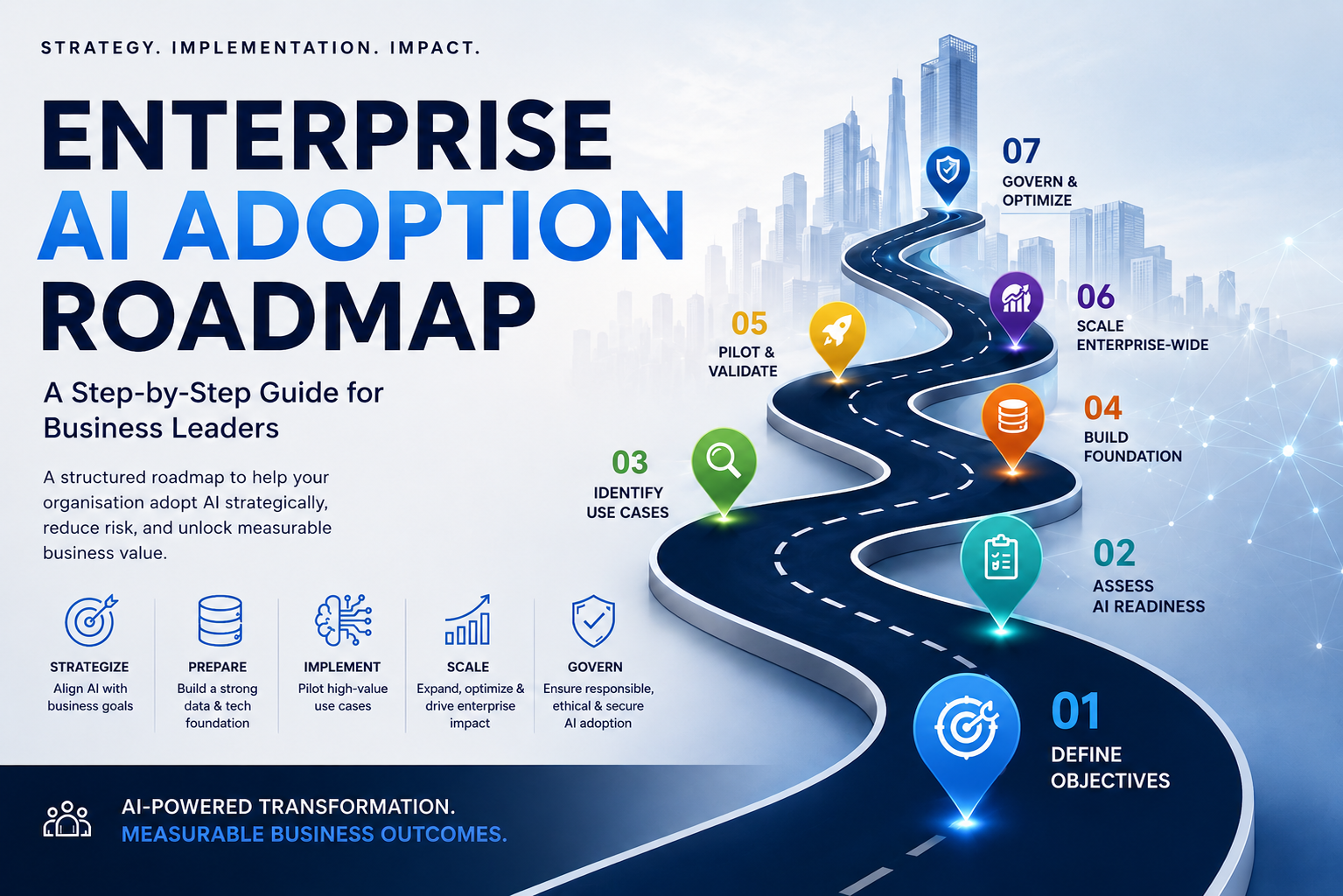
Enterprise AI Adoption Roadmap: A Step-by-Step Guide for Business Leaders
Artificial Intelligence (AI) Doesn’t Create Business Value. Strategy Does.
Artificial Intelligence is no longer a futuristic concept—it is rapidly becoming a strategic business capability. Across industries, organisations are investing in AI to improve productivity, automate repetitive processes, enhance customer experiences, strengthen decision-making, and uncover new growth opportunities.
Yet despite significant investment, many organisations struggle to move beyond isolated AI pilots. Promising proofs of concept often fail to scale, business outcomes remain unclear, and leadership teams are left questioning whether AI is truly delivering value.
The issue is rarely the technology itself.
More often, organisations lack a structured approach to adoption. They implement AI tools before defining business objectives, overlook governance and data readiness, or underestimate the organisational change required for successful transformation.
An Enterprise AI Adoption Roadmap provides the strategic framework to avoid these pitfalls. It aligns technology with business goals, establishes governance, prepares teams, and enables AI initiatives to scale responsibly across the enterprise.
In this guide, we’ll explore the essential phases of enterprise AI adoption, common implementation challenges, and the practical steps organisations can take to transform AI from an experimental technology into a long-term competitive advantage.
Why Enterprises Need an AI Adoption Roadmap
AI is reshaping industries at an unprecedented pace, but successful adoption requires far more than deploying a new platform or integrating a chatbot.
Enterprise organisations face unique challenges:
- Legacy technology environments
- Disconnected data sources
- Regulatory and compliance requirements
- Cybersecurity risks
- Multiple stakeholders and business units
- Workforce adoption and change management
- Difficulty measuring return on investment
Without a structured roadmap, AI initiatives often become isolated projects that fail to integrate with broader business strategies.
An Enterprise AI Adoption Roadmap helps organisations:
- Align AI initiatives with strategic business priorities
- Identify high-value opportunities
- Reduce implementation risks
- Improve governance and compliance
- Accelerate adoption across departments
- Deliver measurable business outcomes
Ultimately, a roadmap transforms AI from a collection of disconnected initiatives into an enterprise-wide capability that drives innovation and sustainable growth.
What Is an Enterprise AI Adoption Roadmap?
An Enterprise AI Adoption Roadmap is a structured plan that guides an organisation through every stage of AI implementation—from strategy and readiness assessment to deployment, governance, and continuous improvement.
Rather than focusing solely on technology, the roadmap considers the people, processes, data, and governance required to ensure AI delivers measurable business value.
A successful roadmap typically addresses:
- Business objectives and success metrics
- AI readiness and organisational maturity
- Data quality and accessibility
- Technology infrastructure
- Governance and ethical AI practices
- Workforce capability and change management
- Ongoing monitoring and optimisation
By treating AI as a business transformation initiative rather than a standalone technology project, organisations are better positioned to achieve sustainable results.
Phase 1: Define Clear Business Objectives
Every successful AI initiative begins with a business problem—not a technology solution.
Before selecting AI platforms or developing use cases, organisations should define what they aim to achieve.
Common objectives include:
- Improving operational efficiency
- Enhancing customer experiences
- Increasing employee productivity
- Reducing operational costs
- Strengthening risk management
- Accelerating innovation
- Supporting better business decisions
Leadership teams should also establish measurable Key Performance Indicators (KPIs) that align AI investments with business outcomes. Examples include reduced processing times, improved customer satisfaction, increased revenue, or lower operational costs.
Clear objectives provide the foundation for every subsequent decision in the AI adoption journey.
Phase 2: Assess Organisational AI Readiness
Many AI projects fail because organisations overestimate their readiness.
An AI Readiness Assessment evaluates whether the organisation has the necessary foundations to support enterprise-wide adoption.
Key assessment areas include:
Data Readiness
- Is business data accurate, accessible, and well-governed?
- Can AI systems access trusted information?
- Are data silos limiting insights?
Technology Infrastructure
- Is the existing infrastructure scalable?
- Are cloud platforms capable of supporting AI workloads?
- Can legacy systems integrate with modern AI solutions?
Governance and Compliance
- Are policies in place for responsible AI use?
- Does the organisation understand regulatory obligations?
- Are privacy and cybersecurity risks addressed?
Workforce Readiness
- Do employees understand AI capabilities?
- Are leaders prepared to drive organisational change?
- Is there a culture that supports innovation?
A comprehensive readiness assessment identifies capability gaps early, allowing organisations to build a stronger foundation before scaling AI initiatives.
Phase 3: Prioritise High-Value AI Use Cases
Not every business process should be automated, and not every AI opportunity delivers equal value.
Successful organisations begin with use cases that offer measurable business impact while remaining feasible to implement.
Examples include:
Customer Service
- AI-powered virtual assistants
- Intelligent knowledge management
- Automated customer support
Finance
- Invoice processing
- Fraud detection
- Financial forecasting
Human Resources
- Recruitment automation
- Employee onboarding
- Workforce analytics
Operations
- Predictive maintenance
- Supply chain optimisation
- Process automation
Sales and Marketing
- Personalised customer engagement
- Sales forecasting
- Lead scoring
- Marketing content generation
Prioritising initiatives based on business value, implementation complexity, and organisational readiness helps build momentum while demonstrating early success.
Phase 4: Establish AI Governance
As AI becomes embedded within enterprise operations, governance becomes critical.
Without appropriate oversight, organisations may face challenges related to bias, security, transparency, regulatory compliance, and reputational risk.
An effective AI governance framework should include:
- Responsible AI principles
- Data privacy policies
- Cybersecurity controls
- Human oversight
- Risk assessment processes
- AI model monitoring
- Ethical decision-making guidelines
- Regulatory compliance frameworks
Governance should enable innovation while maintaining accountability and stakeholder trust.
Phase 5: Build the Right Data and Technology Foundation
Enterprise AI depends on reliable data and scalable technology.
Before expanding AI initiatives, organisations should evaluate:
- Cloud infrastructure
- Enterprise architecture
- Data quality
- Data governance
- API integration
- Security controls
- Identity management
- System interoperability
A modern technology foundation enables AI solutions to integrate seamlessly with existing business systems while supporting future innovation.
Phase 6: Launch Pilot Projects
Rather than attempting enterprise-wide implementation immediately, organisations should begin with focused pilot initiatives.
Successful pilot projects should:
- Solve a real business problem
- Have clearly defined objectives
- Deliver measurable outcomes
- Involve key stakeholders
- Produce lessons for future scaling
Early wins build organisational confidence and provide valuable insights before expanding AI adoption across additional business functions.
Phase 7: Scale AI Across the Enterprise
Once pilot initiatives demonstrate value, organisations can begin scaling AI across departments.
Successful scaling requires:
- Executive sponsorship
- Cross-functional collaboration
- Standardised governance
- Employee training
- Ongoing performance monitoring
- Continuous optimisation
AI adoption should evolve into an organisational capability rather than remaining isolated within individual teams.
Common Reasons Enterprise AI Projects Fail
Many organisations encounter similar obstacles during AI adoption:
- Lack of strategic alignment
- Poor data quality
- Weak executive sponsorship
- Insufficient change management
- Unrealistic expectations
- Limited governance
- Inadequate workforce training
- Difficulty measuring business value
Recognising these challenges early enables organisations to proactively address risks before they affect project outcomes.
Best Practices for Enterprise AI Adoption
To maximise long-term success, organisations should:
- Align AI initiatives with business strategy
- Start with high-value use cases
- Invest in data quality and governance
- Develop responsible AI policies
- Build multidisciplinary teams
- Continuously measure performance
- Upskill employees
- Treat AI as an ongoing transformation journey
How Chrysalis Helps Organisations Accelerate AI Adoption
At Chrysalis, we understand that successful AI adoption requires more than implementing technology—it demands a clear strategy, strong governance, and a focus on measurable business outcomes.
Our team partners with organisations to:
- Develop enterprise AI strategies aligned with business goals
- Conduct AI readiness assessments
- Identify high-impact AI opportunities
- Design responsible AI governance frameworks
- Modernise technology environments
- Implement intelligent automation solutions
- Support workforce enablement and organisational change
- Optimise AI initiatives for long-term business value
Whether you’re exploring AI for the first time or scaling enterprise-wide initiatives, Chrysalis provides the expertise needed to navigate the journey with confidence.
Conclusion
Enterprise AI is no longer an emerging trend—it is becoming a defining capability for organisations seeking long-term competitiveness.
However, technology alone does not guarantee success. Organisations that approach AI with a clear strategy, strong governance, quality data, and a commitment to continuous improvement are far more likely to achieve meaningful business outcomes.
An Enterprise AI Adoption Roadmap provides the structure needed to move beyond experimentation and build AI capabilities that deliver lasting value across the enterprise.
If your organisation is ready to transform AI ambitions into measurable business outcomes, partnering with experienced AI consultants can help accelerate your journey while reducing implementation risks.
Frequently Asked Questions
-
What is an Enterprise AI Adoption Roadmap?
It is a structured framework that guides organisations through planning, implementing, governing, and scaling AI initiatives to achieve measurable business outcomes.
-
Why do AI projects fail in enterprises?
Common reasons include unclear business objectives, poor data quality, weak executive sponsorship, lack of governance, inadequate change management, and unrealistic expectations.
-
How long does enterprise AI adoption take?
The timeline depends on organisational size, AI maturity, technology infrastructure, and project scope. Many organisations begin with pilot projects before scaling over several months or years.
-
What is an AI Readiness Assessment?
An AI Readiness Assessment evaluates an organisation’s data, technology, governance, workforce, and culture to determine its preparedness for successful AI adoption.
-
What industries benefit most from Enterprise AI?
AI delivers value across sectors including banking, healthcare, government, retail, manufacturing, insurance, logistics, telecommunications, and professional services.
-
How can Chrysalis help with enterprise AI adoption?
Chrysalis provides AI strategy, readiness assessments, governance frameworks, intelligent automation, digital transformation consulting, and implementation support to help organisations adopt AI responsibly and achieve measurable business value.