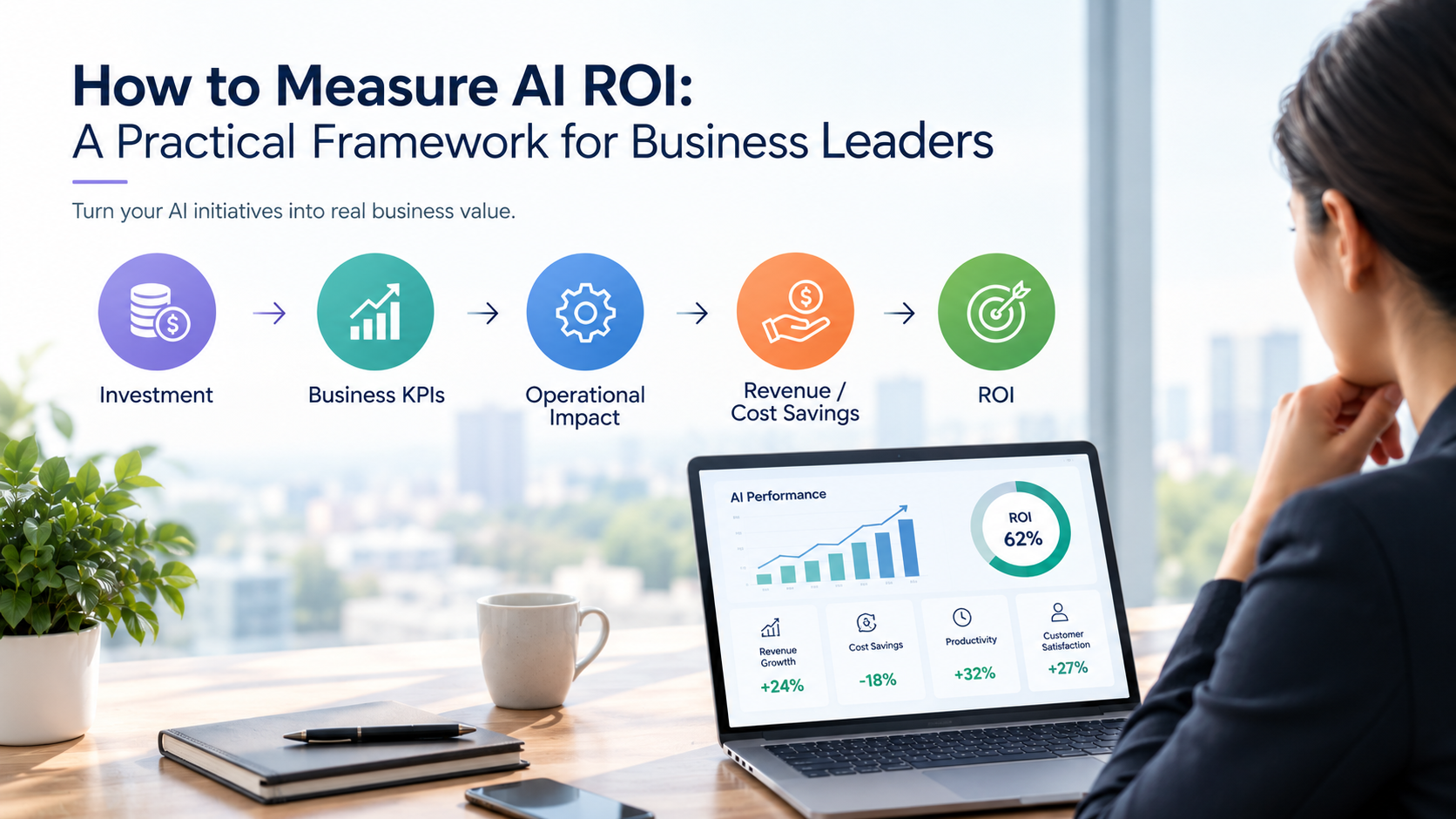
How to Measure AI ROI: A Practical Framework for Business Leaders
Artificial intelligence is moving rapidly from experimentation to business operations.
Companies are using AI to automate workflows, analyse data, improve customer experiences, support employees, generate insights and accelerate decision-making. But as AI investment increases, business leaders are facing a more important question:
Is our AI actually creating measurable business value?
Buying an AI platform, deploying an AI agent or automating a workflow does not automatically create return on investment. The real value comes when AI improves a measurable business outcome — such as reducing operating costs, increasing revenue, improving productivity, reducing processing time or strengthening customer retention.
That makes AI ROI more than a technology metric. It is a business performance metric.
What Is AI ROI?
AI ROI, or return on investment from artificial intelligence, measures the business value generated by an AI initiative compared with the total cost of implementing and operating it.
A simple financial formula is:
AI ROI = (Financial Benefit − Total AI Investment) ÷ Total AI Investment × 100
However, enterprise AI is more complicated than a single formula.
An AI solution may generate direct financial returns while also producing operational, customer or strategic benefits that are harder to quantify.
For example, an AI-powered customer service system could:
- Reduce average handling time
- Lower support costs
- Increase customer response speed
- Improve employee productivity
- Reduce repetitive work
- Increase customer satisfaction
- Help support more customers without proportionally increasing headcount
A strong AI ROI framework therefore needs to measure both financial outcomes and operational outcomes.
AI success should not be measured by model performance alone. Businesses need to connect technical performance with user adoption, operational improvements, and measurable financial outcomes.
Why Is Measuring AI ROI So Difficult?
The challenge is not necessarily a lack of data.
The bigger problem is connecting AI activity to actual business outcomes.
Consider an organisation that introduces an AI assistant for its sales team.
The technology team might measure:
- Number of users
- Number of AI interactions
- Response time
- Model accuracy
- API usage
These metrics tell you whether the technology is being used.
They do not necessarily tell you whether the business is better because of it.
A CEO or CFO is more likely to ask:
Did sales productivity increase?
Did conversion rates improve?
Did operating costs decrease?
Did employees save meaningful time?
Did revenue increase?
Was the investment worth the total cost?
That difference — between technology activity and business impact — is where many AI ROI programmes become difficult.
The 5 Layers of AI ROI Measurement
A practical approach is to measure AI across five connected layers.
1. Financial Impact
Start with the numbers that matter to the business.
Depending on the AI use case, this could include:
- Revenue increase
- Cost reduction
- Margin improvement
- Cost per transaction
- Revenue per employee
- Customer acquisition cost
- Customer retention
- Total cost of ownership
For example, suppose an organisation invests $100,000 in an AI-powered process automation project.
If the solution produces $160,000 in measurable annual financial benefit:
AI ROI = ($160,000 − $100,000) ÷ $100,000 × 100
AI ROI = 60%
But the calculation is only useful if the $160,000 benefit can be reasonably attributed to the AI initiative.
That is why establishing a baseline before implementation is critical.
A strong AI ROI measurement process starts before deployment: establish a clear baseline, define success criteria, and determine how much of the resulting improvement can reasonably be attributed to AI.
2. Strategic Business Outcomes
Not every valuable AI outcome appears immediately on the profit-and-loss statement.
AI may help an organisation:
- Enter a market faster
- Improve decision-making
- Respond to customers more quickly
- Increase organisational agility
- Create new digital products
- Improve competitive positioning
- Build scalable operating capabilities
These outcomes should still be tracked.
For example, reducing the time required to produce a complex management report from five days to five hours may not immediately appear as additional revenue.
But it can significantly improve management responsiveness.
This is why AI ROI should not be confused with immediate cost savings alone.
3. Operational Performance
This is where many AI initiatives can demonstrate measurable value.
Useful operational KPIs include:
| Business Area | Possible AI ROI Metric |
| Customer service | Average handling time |
| Sales | Lead qualification time |
| Finance | Invoice processing time |
| HR | Recruitment screening time |
| Operations | Processing cost per transaction |
| Marketing | Campaign production time |
| IT | Incident resolution time |
| Supply chain | Forecast accuracy |
| Compliance | Review and processing time |
The key is to compare the before and after state.
For example:
Before AI: 500 invoices processed manually per week
After AI: 500 invoices processed with 60% less manual effort
The second measurement is much more meaningful than simply saying:
“AI processed 500 invoices.”
4. User Adoption and Behaviour
An AI solution cannot generate sustainable ROI if employees do not use it effectively.
That makes adoption an important part of AI measurement.
Track:
- Active users
- Frequency of use
- Workflow adoption
- Task completion
- Employee acceptance
- Training completion
- Human intervention rates
- Abandonment rates
Consider an AI assistant that was designed for 1,000 employees but is regularly used by only 100.
Technically, the project may be working.
From a business perspective, however, its realised value may be significantly below its potential.
Deployment is not adoption.
And adoption is not the same as business impact.
A mature AI ROI programme connects all three.
5. AI System Performance
Technical performance still matters.
Depending on the application, businesses may need to monitor:
- Accuracy
- Response time
- Reliability
- Hallucination or error rates
- System availability
- Model costs
- Token or inference usage
- Security incidents
- Human escalation rates
These metrics should not replace business KPIs.
Instead, they should help explain business performance.
For example:
Lower AI accuracy → more human intervention → longer processing time → higher operating cost
This creates a measurable connection between technology performance and business value.
A Practical AI ROI Framework
Before launching an AI initiative, business leaders should answer six questions.
Step 1: Define the Business Problem
Do not start with:
“Where can we use AI?”
Start with:
“Which business problem is worth solving?”
Examples include:
- High customer service costs
- Slow claims processing
- Manual document processing
- Low sales productivity
- Poor forecasting
- Repetitive administrative work
- Long response times
- Data analysis bottlenecks
This approach prevents businesses from implementing AI simply because the technology is available.
Step 2: Establish the Baseline
Measure the existing process before introducing AI.
Document:
- Current cost
- Current processing time
- Current error rate
- Current workforce effort
- Current conversion rate
- Current customer experience
- Current revenue contribution
Without a baseline, it becomes difficult to prove improvement.
Step 3: Define the Expected Value
Set measurable targets before development begins.
For example:
Business goal: Reduce customer support costs.
Baseline: $500,000 annual support cost.
AI target: Reduce avoidable support workload by 20%.
Expected financial benefit: $100,000 annually.
Now the AI project has a measurable business case.
Step 4: Calculate the Total Cost
AI investment is not limited to the software licence.
Consider:
- AI platforms
- Development
- Integration
- Data preparation
- Cloud infrastructure
- APIs
- Security
- Governance
- Training
- Change management
- Maintenance
- Monitoring
- Ongoing model or usage costs
This is particularly important as AI systems move into production. McKinsey notes that total cost of ownership, including infrastructure and usage-related costs, needs to be connected to the financial impact of AI initiatives.
Step 5: Measure Incremental Impact
After implementation, compare results against the baseline.
Do not simply ask:
“Is the AI system working?”
Ask:
“What changed because of the AI system?”
This distinction is critical.
For stronger attribution, organisations can use controlled experiments, A/B testing, phased deployment or comparison groups where practical.
Step 6: Review and Scale
AI ROI should not be calculated once and forgotten.
Create a regular review cycle.
A useful management dashboard could include:
Investment → Adoption → Operational Impact → Financial Impact → Risk
Use the results to decide whether the initiative should be:
- Scaled
- Improved
- Reconfigured
- Paused
- Replaced
A practical approach is to evaluate AI initiatives in stages, using measurable results from each phase to decide whether the project should be scaled, adjusted, or stopped.
Hard ROI vs Soft ROI
One of the biggest mistakes organisations make is measuring only direct financial returns.
Hard ROI
Hard ROI can usually be connected directly to financial results.
Examples:
- Reduced labour cost
- Increased sales
- Lower infrastructure costs
- Reduced processing costs
- Reduced customer churn
- Increased revenue
Soft ROI
Soft ROI may be more difficult to translate immediately into financial figures.
Examples:
- Employee experience
- Customer satisfaction
- Faster decision-making
- Improved knowledge access
- Better collaboration
- Improved business agility
- Reduced employee workload
Soft ROI should not be ignored.
Instead, organisations should identify whether a soft benefit can eventually influence a measurable business outcome.
For example:
AI knowledge assistant
↓
Employees find information faster
↓
Less time spent searching
↓
Higher productivity
↓
More capacity for customer-facing work
↓
Potential revenue or cost impact
This creates a stronger business case than simply reporting “employees like the AI assistant.”
Common AI ROI Measurement Mistakes
1. Measuring AI Activity Instead of Business Value
The number of prompts, users or automated tasks does not automatically equal ROI.
2. Ignoring the Baseline
Without knowing where the business started, improvement becomes difficult to prove.
3. Measuring Only Cost Savings
AI can create revenue, improve customer retention, accelerate decisions and create new capabilities.
4. Ignoring Total Cost of Ownership
A project may appear profitable if only the initial implementation cost is counted.
5. Scaling Before Proving Value
More AI does not necessarily mean more business value.
A use case should demonstrate measurable impact before significant expansion.
6. Treating AI as a One-Time Project
AI performance, costs, adoption and business value can change after deployment.
ROI needs ongoing monitoring.
What Should CEOs Ask Before Approving an AI Investment?
Before approving an AI initiative, leadership teams should be able to answer:
1. What business problem are we solving?
If the answer is unclear, the AI project may be technology-led rather than business-led.
2. What is the current cost of the problem?
Quantify the baseline wherever possible.
3. What outcome will AI change?
Identify the KPI that should improve.
4. How will we measure attribution?
Determine how the organisation will distinguish AI-driven impact from other business changes.
5. What is the total cost?
Include implementation, integration, training, governance and ongoing operation.
6. What happens if the AI works?
Define how the solution will scale.
7. What happens if it doesn’t?
Establish review points and stop/go criteria.
This turns AI investment from an open-ended technology experiment into a managed business initiative.
The Future of AI ROI Is Moving Beyond Productivity
Productivity remains an important AI outcome, but the next stage of AI adoption will require businesses to think much more broadly.
AI can influence:
- Revenue generation
- Customer experience
- Operational efficiency
- Decision intelligence
- Risk management
- Product development
- Workforce productivity
- Business agility
AI ROI should therefore be measured across multiple dimensions, including financial return, revenue growth, operational savings, and how quickly those benefits are achieved.
For enterprise leaders, the question is therefore changing.
It is no longer:
“How much AI are we using?”
It is:
“How much measurable business value are we creating with AI?”
That is a much more useful question.
How Chrysalis Helps Businesses Turn AI Investment Into Business Value
At Chrysalis, AI adoption starts with the business problem — not simply the technology.
Our approach combines AI consulting, digital transformation, intelligent automation, data-driven insights and technology integration to help organisations identify where AI can create meaningful business impact.
The process can include:
Business assessment → Opportunity identification → AI strategy → Process optimisation → Solution implementation → Measurement → Continuous improvement
This helps organisations move from isolated AI experiments toward practical, measurable transformation.
Chrysalis supports organisations across areas including AI-driven digital transformation, intelligent automation, IT consulting and strategy, managed services and AI-powered business solutions.
The objective is not to implement AI for the sake of implementing AI.
The objective is to make technology work harder for the business.
Final Thoughts
AI investment is entering a more accountable phase.
Businesses can no longer evaluate AI success simply by counting pilots, tools, models or automated workflows.
The organisations that create sustainable value will connect AI initiatives to measurable business outcomes.
That means establishing a baseline, defining success criteria, measuring adoption, tracking operational improvements, calculating total cost and continuously evaluating financial impact.
In simple terms:
AI adoption creates activity.
AI implementation creates capability.
But measurable business outcomes create ROI.
And that is where successful AI transformation begins.
Frequently Asked Questions
What is AI ROI?
AI ROI measures the business value generated by an artificial intelligence initiative compared with the total cost of implementing and operating it.
How do you calculate AI ROI?
A basic formula is: (Financial Benefit − Total AI Investment) ÷ Total AI Investment × 100. However, enterprise AI should also consider operational, strategic, customer and adoption metrics.
What KPIs should businesses use to measure AI ROI?
Depending on the use case, businesses can measure revenue growth, cost reduction, productivity, processing time, customer retention, conversion rates, accuracy, adoption and total cost of ownership.
Why is AI ROI difficult to measure?
AI often works alongside changes in data, processes, workforce and technology. This can make it difficult to isolate the specific contribution of AI.
Should businesses measure AI productivity or financial ROI?
Both. Productivity metrics can demonstrate operational improvement, while financial metrics help leadership understand whether the investment is creating economic value.
When should a business calculate AI ROI?
Ideally, before implementation begins. Establishing a baseline and defining success criteria before deployment makes post-implementation measurement significantly more meaningful.
How can an AI consulting company help measure AI ROI?
An AI consulting partner can help identify suitable use cases, establish baselines, define KPIs, design measurement frameworks, assess technology and process requirements, and connect AI initiatives to broader business objectives.