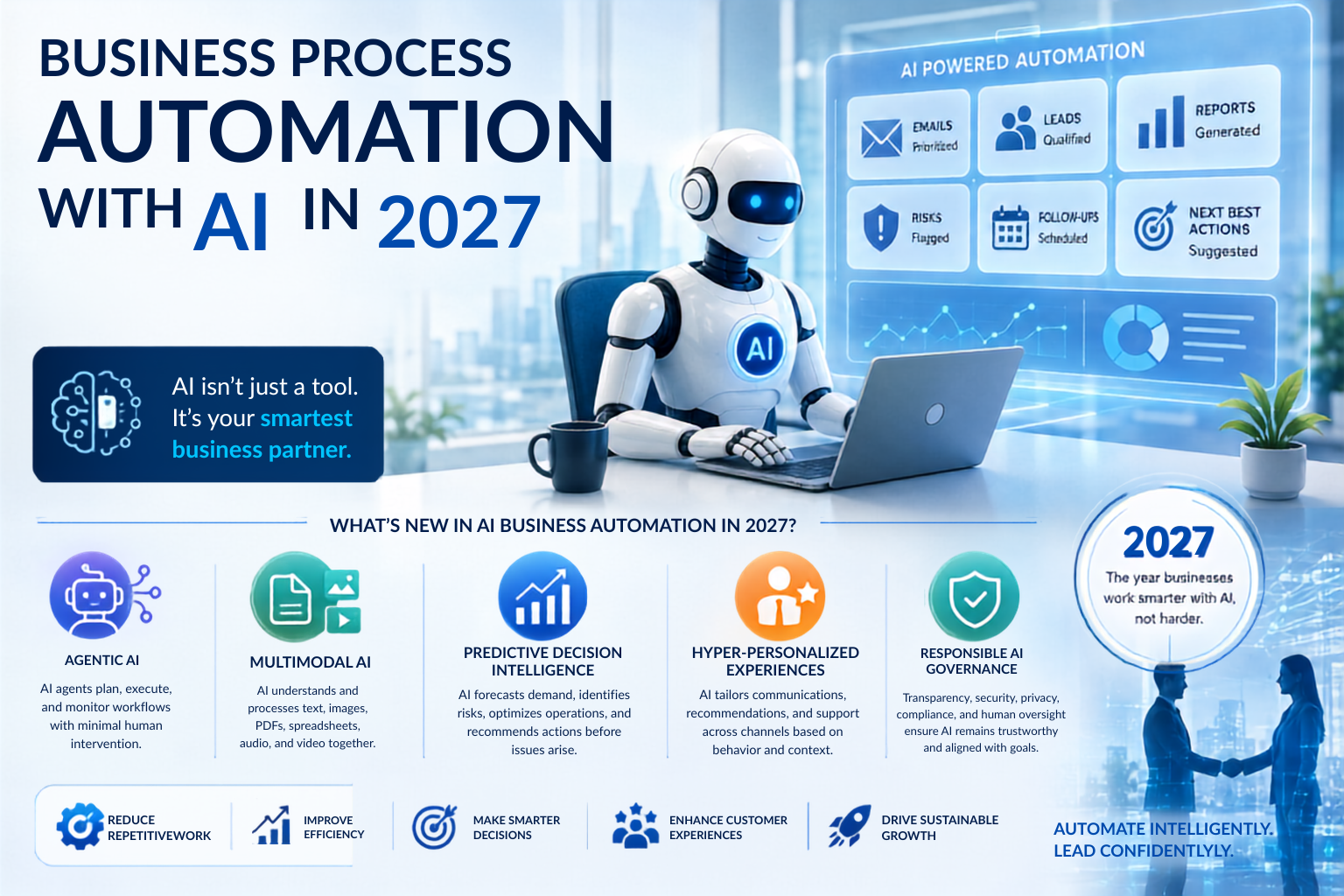
Business Process Automation with AI in 2027: Why the Fastest-Growing Companies Are Automating Everything Except Human Creativity
Do you believe in Business Process Automation with AI?
Imagine walking into your office on a Monday morning and discovering that your AI has already prioritized emails, qualified overnight leads, generated weekly reports, flagged potential business risks, scheduled customer follow-ups, and even suggested the next best actions for your sales team.
This isn’t a glimpse of the future anymore.
It’s how forward-thinking businesses are operating in 2027.
Artificial Intelligence has evolved from being a productivity tool to becoming a strategic business partner. Organizations are no longer asking, “Should we use AI?” Instead, they’re asking, “Which business process should we automate next?”
Companies that continue relying on manual workflows are finding it increasingly difficult to compete with organizations that deliver faster customer service, make data-driven decisions in real time, and operate with greater efficiency through AI-powered automation.
In this guide, you’ll learn how Business Process Automation with AI is reshaping modern enterprises, the processes that deliver the highest return on investment, and how your organization can implement AI responsibly to achieve measurable business outcomes in 2027.
What’s New in AI Business Automation in 2027?
The landscape has evolved significantly. Businesses are moving beyond simple chatbots and workflow automation toward intelligent, autonomous systems that can collaborate with employees.
Agentic AI
AI agents can now plan, execute, and monitor multi-step business workflows with minimal human intervention while operating within defined business rules and governance.
Multimodal AI
Modern AI systems can understand and process text, images, PDFs, spreadsheets, audio, and video together, enabling automation across far more complex business processes.
Predictive Decision Intelligence
Instead of only reporting what happened, AI increasingly helps organizations forecast demand, identify operational risks, optimize inventory, and recommend business actions before issues arise.
Hyper-Personalized Customer Experiences
AI enables businesses to tailor communications, recommendations, and support based on customer preferences, behavior, and context across multiple channels.
Responsible AI Governance
As AI adoption grows, organizations are placing greater emphasis on transparency, security, privacy, compliance, and human oversight to ensure automation remains trustworthy and aligned with business objectives.
The Future of Business Isn’t More Manual Work—It’s Smarter Work
In 2027, successful organizations aren’t simply working harder—they’re designing systems that allow people and AI to collaborate effectively.
The businesses seeing the greatest gains aren’t replacing their employees. They’re freeing their teams from repetitive tasks so they can focus on innovation, customer relationships, strategy, and growth.
Business Process Automation with AI is no longer a competitive advantage reserved for large enterprises. It’s becoming a core capability for organizations of every size that want to improve productivity, enhance customer experiences, and remain resilient in a rapidly changing market.
The question is no longer whether AI will transform business operations.
The question is whether your business will lead that transformation—or spend the coming years trying to catch up.
Is AI Business Process Automation worth investing in in 2027?
Yes. For many organizations, AI automation is delivering value by reducing repetitive work, improving operational efficiency, supporting better decision-making, and enhancing customer experiences. The most successful initiatives typically start with well-defined, high-impact workflows and scale over time.
The Future Belongs to Businesses That Automate Intelligently
Every business reaches a point where hiring more people is no longer the most efficient path to growth.
The smarter approach is to empower existing teams with intelligent automation.
Business Process Automation with AI isn’t about replacing human potential—it’s about removing the repetitive work that limits it.
Organizations that embrace AI today are building operations that are faster, more resilient, and ready for tomorrow’s challenges. Those that wait risk falling behind competitors who can deliver more value with greater speed and efficiency.
If your goal is sustainable growth, improved customer experiences, and operational excellence, AI-powered automation is no longer optional—it has become a strategic advantage.
Key Takeaways
- AI-powered automation goes beyond rule-based workflows by learning, adapting, and making intelligent decisions.
- Every department—from sales and finance to HR and customer support—can benefit from AI-driven process automation.
- Businesses can reduce costs, improve productivity, increase accuracy, and scale more efficiently with intelligent automation.
- Starting with one high-impact process and expanding gradually is often the most effective adoption strategy.
- Partnering with experienced AI and digital transformation specialists helps maximize ROI and ensures successful implementation.
Frequently Asked Questions (FAQ)
What is Business Process Automation with AI?
Business Process Automation with AI combines workflow automation and artificial intelligence to automate repetitive tasks, improve decision-making, and optimize business operations with minimal human intervention.
How does AI improve business process automation?
AI enables automation to understand language, analyze data, recognize patterns, make predictions, and adapt to changing business conditions—capabilities that traditional rule-based automation cannot provide.
Which industries benefit most from AI automation?
Healthcare, finance, manufacturing, logistics, retail, insurance, education, government, and professional services all use AI automation to streamline operations and improve efficiency.
Is AI automation suitable for small businesses?
Yes. Many AI tools are cloud-based and scalable, allowing small and medium-sized businesses to automate specific processes without major infrastructure investments.
What are the biggest benefits of AI automation?
Key benefits include:
- Higher productivity
- Lower operational costs
- Improved accuracy
- Faster decision-making
- Better customer experiences
- Enhanced scalability
- Stronger compliance
How long does AI automation implementation take?
The timeline depends on process complexity. Simple workflows may be implemented within weeks, while enterprise-wide automation programs can take several months and are often delivered in phases.