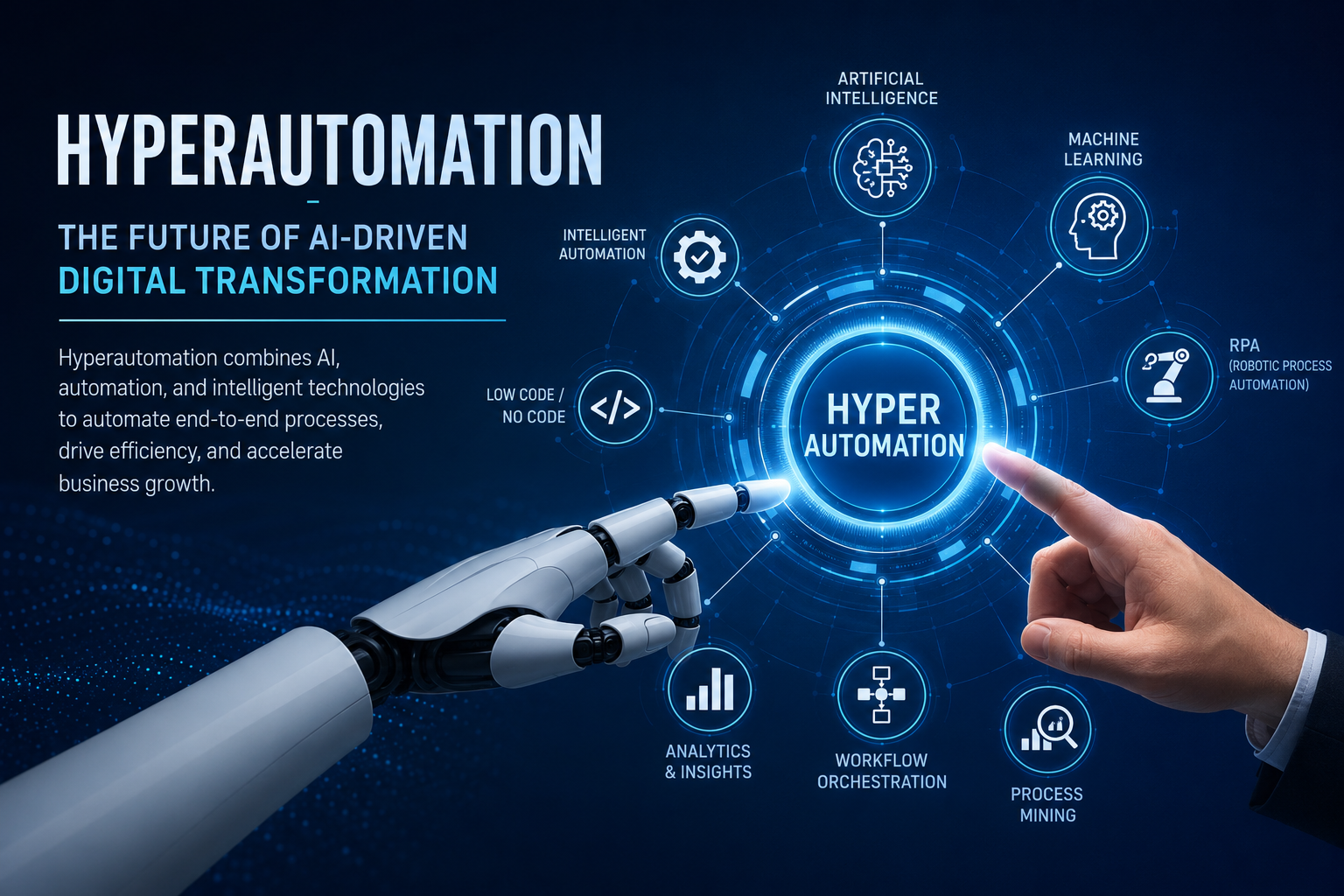
Hyperautomation: The Next Evolution of Digital Transformation with AI
Businesses are no longer asking whether they should automate—they’re asking how far automation can go.
Traditional automation solved repetitive tasks. Artificial Intelligence (AI) introduced intelligent decision-making. Today, Hyperautomation combines these technologies to create end-to-end intelligent business operations that are faster, smarter, and more scalable.
For organizations looking to remain competitive, hyperautomation has become a critical pillar of digital transformation rather than an optional innovation.
Whether you’re a manufacturing company, healthcare provider, financial institution, retailer, or logistics enterprise, hyperautomation helps eliminate operational bottlenecks while improving customer experiences and business agility. It combines AI, robotic process automation (RPA), workflow orchestration, process mining, and analytics to automate not just tasks, but entire business processes.
What is Hyperautomation?
Hyperautomation is a business-driven approach that uses multiple advanced technologies—including Artificial Intelligence (AI), Machine Learning (ML), Robotic Process Automation (RPA), Business Process Management (BPM), process mining, and low-code platforms—to automate complex business processes from start to finish.
Unlike traditional automation that focuses on one repetitive task, hyperautomation creates an intelligent ecosystem where multiple systems work together with minimal human intervention.
Think of it as moving from:
Task Automation → Process Automation → Intelligent Enterprise Automation
Why Hyperautomation Matters in 2026
Businesses face growing challenges:
- Increasing operational costs
- Shortage of skilled workforce
- Rising customer expectations
- Complex compliance requirements
- Massive volumes of business data
Hyperautomation addresses these challenges by enabling organizations to:
- Reduce manual work
- Improve operational efficiency
- Increase accuracy
- Make faster business decisions
- Scale operations without proportionally increasing workforce
Industry analysts also view hyperautomation as a foundational capability for modern AI-powered enterprises.
Hyperautomation vs Traditional Automation
| Traditional Automation | Hyperautomation |
| Automates individual tasks | Automates complete workflows |
| Rule-based | AI-powered decision making |
| Limited integrations | Enterprise-wide integrations |
| Static workflows | Adaptive and intelligent workflows |
| Human supervision required | Continuous optimization using AI |
| Department-specific | Cross-functional automation |
Core Technologies Behind Hyperautomation
Artificial Intelligence (AI)
AI enables systems to understand language, recognize patterns, predict outcomes, and make intelligent decisions instead of following fixed rules.
Examples include:
- AI chatbots
- Predictive analytics
- Document understanding
- Recommendation engines
Robotic Process Automation (RPA)
Software bots perform repetitive activities like:
- Invoice processing
- Data migration
- Form filling
- Report generation
Machine Learning
Machine Learning continuously improves business decisions by learning from historical data.
Examples:
- Fraud detection
- Customer churn prediction
- Demand forecasting
Process Mining
Process mining discovers hidden inefficiencies by analyzing event logs from business systems.
Organizations can identify:
- Process bottlenecks
- Delays
- Compliance gaps
- Automation opportunities
Workflow Orchestration
Workflow orchestration connects multiple business systems into one seamless automated process.
Example:
Customer Order
↓
Inventory Check
↓
Payment Verification
↓
Invoice Creation
↓
Warehouse Dispatch
↓
Delivery Notification
All completed automatically.
Real-World Hyperautomation Use Cases
Banking & Financial Services
Banks automate:
- Loan approvals
- Fraud detection
- KYC verification
- Customer onboarding
- Compliance reporting
Result:
- Faster approvals
- Lower operational cost
- Better customer experience
Healthcare
Hospitals use hyperautomation for:
- Patient scheduling
- Insurance verification
- Medical document processing
- Billing automation
Healthcare professionals spend less time on paperwork and more time treating patients.
Manufacturing
Manufacturers automate:
- Supply chain monitoring
- Predictive maintenance
- Production scheduling
- Quality inspections
Result:
- Reduced downtime
- Improved productivity
- Better inventory control
Retail & Ecommerce
Retail businesses automate:
- Product recommendations
- Customer support
- Inventory replenishment
- Order processing
AI also predicts buying behavior for personalized experiences.
Human Resources
HR departments automate:
- Resume screening
- Employee onboarding
- Payroll
- Leave management
- Performance reporting
Benefits of Hyperautomation
1. Increased Productivity
Employees focus on strategic work while repetitive tasks are automated.
2. Reduced Operational Costs
Automation significantly lowers manual effort and minimizes costly errors.
3. Better Customer Experience
Customers receive:
- Faster responses
- Personalized interactions
- 24/7 service availability
4. Improved Decision Making
AI analyzes massive datasets in real time to support informed business decisions.
5. Higher Accuracy
Automated workflows reduce human error in finance, healthcare, logistics, and compliance.
6. Scalability
Businesses can expand operations without proportionally increasing workforce or operational expenses.
Common Challenges in Hyperautomation
Despite its benefits, implementation requires careful planning.
Challenges include:
- Legacy system integration
- Data quality issues
- Employee adoption
- Security and governance
- Change management
This is why organizations often partner with an experienced digital transformation company capable of designing scalable automation strategies tailored to their business goals.
Why Businesses Need an AI Company for Hyperautomation
Technology alone doesn’t guarantee success.
A specialized AI company helps organizations:
- Identify automation opportunities
- Build AI models
- Integrate enterprise systems
- Develop intelligent workflows
- Monitor AI performance
- Ensure responsible AI implementation
Instead of deploying isolated automation tools, experienced AI consultants create connected digital ecosystems that continuously improve over time.
How Chrysalis Enables Hyperautomation
At Chrysalis, we help businesses accelerate intelligent automation through strategic digital transformation initiatives.
Our capabilities include:
- AI Strategy & Consulting
- Intelligent Process Automation
- Generative AI Solutions
- Enterprise AI Integration
- Workflow Automation
- Data & Analytics
- Cloud Transformation
- Business Process Optimization
As a trusted digital transformation company and AI company, we focus on building scalable automation solutions that improve operational efficiency, reduce costs, and unlock measurable business value.
Future Trends in Hyperautomation
The next wave of hyperautomation will be driven by:
- Agentic AI
- Autonomous Business Operations
- AI-powered Decision Intelligence
- Digital Twins
- Intelligent Document Processing
- Conversational AI
- Predictive Process Optimization
Organizations that invest today will be better positioned to adapt, innovate, and compete in increasingly AI-driven markets.
Final Thoughts
Hyperautomation represents the next stage of enterprise evolution.
It combines AI, automation, analytics, and intelligent workflows to transform entire business operations—not just isolated tasks.
Businesses that embrace hyperautomation gain greater efficiency, faster decision-making, improved customer experiences, and long-term competitive advantages.
Whether you’re beginning your automation journey or scaling enterprise-wide AI initiatives, partnering with an experienced digital transformation company and AI company can significantly accelerate success.
If you’re ready to build intelligent, future-ready business operations, Chrysaliss can help you design, implement, and optimize a hyperautomation strategy tailored to your organization.
Frequently Asked Questions (FAQs)
1. What is hyperautomation in simple terms?
Hyperautomation is the use of technologies like Artificial Intelligence (AI), Robotic Process Automation (RPA), Machine Learning (ML), and workflow automation to automate entire business processes. Unlike basic automation, it enables systems to make intelligent decisions and continuously improve operations.
2. How is hyperautomation different from automation?
Traditional automation focuses on repetitive, rule-based tasks, while hyperautomation combines AI, RPA, analytics, and process orchestration to automate end-to-end workflows. This allows businesses to streamline complex processes across multiple departments.
3. What technologies are used in hyperautomation?
Hyperautomation typically includes:
- Artificial Intelligence (AI)
- Robotic Process Automation (RPA)
- Machine Learning (ML)
- Business Process Management (BPM)
- Process Mining
- Intelligent Document Processing (IDP)
- Low-code/No-code platforms
- Workflow Orchestration
These technologies work together to create intelligent and scalable business automation.
4. What are the benefits of hyperautomation for businesses?
Hyperautomation helps organizations:
- Reduce operational costs
- Improve productivity
- Minimize human errors
- Accelerate decision-making
- Enhance customer experience
- Increase scalability
- Ensure better compliance and governance
5. Which industries benefit the most from hyperautomation?
Hyperautomation delivers value across many industries, including:
- Healthcare
- Banking and Financial Services
- Manufacturing
- Retail and E-commerce
- Logistics and Supply Chain
- Insurance
- Telecommunications
- Human Resources
Any business with repetitive or data-intensive processes can benefit from hyperautomation.
6. Why should businesses partner with a digital transformation company for hyperautomation?
A digital transformation company helps businesses identify automation opportunities, integrate AI technologies, modernize legacy systems, and implement scalable automation strategies. This ensures faster deployment, reduced risks, and a higher return on investment.
7. How does an AI company support hyperautomation initiatives?
An experienced AI company develops intelligent solutions such as predictive analytics, AI-powered chatbots, intelligent document processing, and decision-support systems. These capabilities make hyperautomation smarter, more adaptive, and capable of handling complex business scenarios.
8. Is hyperautomation suitable for small and medium-sized businesses (SMBs)?
Yes. Modern cloud-based AI and automation platforms make hyperautomation accessible to businesses of all sizes. SMBs can start by automating key workflows and gradually scale their automation initiatives as they grow.
9. What is the future of hyperautomation?
The future of hyperautomation includes Agentic AI, autonomous business operations, generative AI integration, predictive process optimization, and intelligent decision-making. As AI technologies evolve, hyperautomation will become a core component of enterprise digital transformation strategies.
10. How can Chrysalis help with hyperautomation?
As a trusted digital transformation company and AI company, Chrysalis helps organizations design, implement, and optimize hyperautomation solutions. From AI strategy and intelligent workflow automation to enterprise integration and process optimization, Chrysaliss enables businesses to accelerate innovation and achieve sustainable growth.