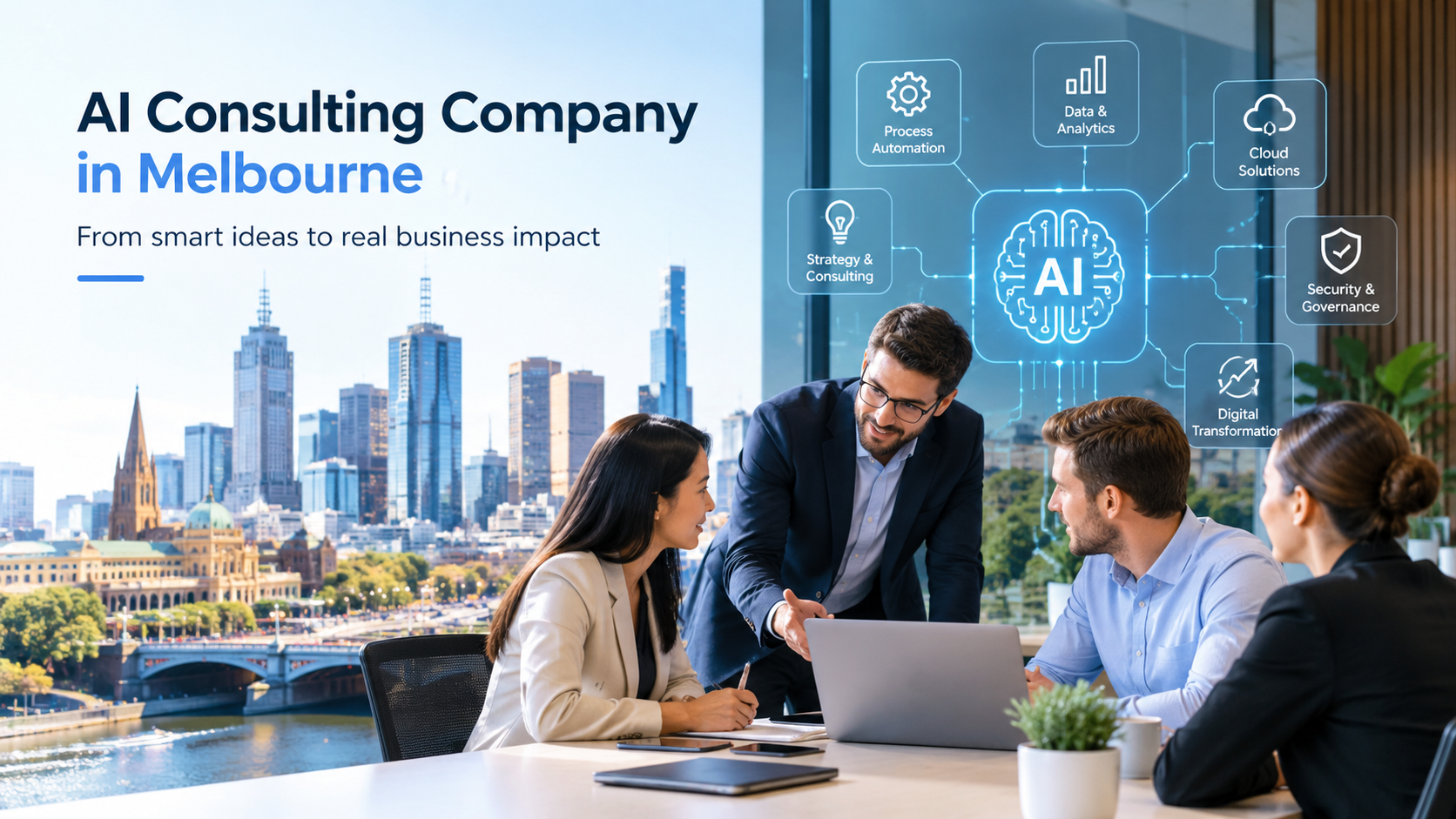
AI Consulting Company in Melbourne: How to Turn AI Into Practical Business Results
Artificial intelligence is becoming part of everyday business operations, but choosing the right technology is only one part of the challenge. For businesses in Melbourne, the real question is how to use AI to reduce repetitive work, improve decision-making, strengthen customer experiences and support long-term growth without adding unnecessary complexity.
An experienced AI consulting company in Melbourne can help organisations move from exploring AI tools to identifying practical applications that fit their business objectives, existing systems and operational requirements.
Chrysalis works across artificial intelligence, digital transformation, IT consulting, analytics, cloud services and robotic process automation. This combination is relevant for businesses that need to connect AI initiatives with broader technology and operational improvements rather than implement isolated tools.
This guide explains how AI consulting works, where businesses can apply AI, what to consider before investing and how to evaluate an AI consulting partner.
What Does an AI Consulting Company in Melbourne Do?
An AI consulting company helps businesses determine where artificial intelligence can deliver practical value and how to implement it responsibly within their existing operations.
The work goes beyond recommending AI software. It involves understanding business processes, assessing data readiness, identifying suitable use cases, evaluating technical requirements and planning implementation.
Depending on the organisation’s needs, AI consulting may involve:
- AI strategy and readiness assessment: Understanding business objectives, existing technology, data quality and operational constraints before committing to an AI project.
- Intelligent process automation: Identifying repetitive, rule-based or document-heavy tasks that could be streamlined through AI and automation.
- AI integration: Connecting suitable AI capabilities with existing business applications, data sources and workflows.
- Data and analytics: Making business information easier to interpret so decision-makers can work with more consistent and useful insights.
- Digital transformation: Aligning AI initiatives with wider improvements to systems, processes and customer experiences.
- Governance and risk assessment: Considering privacy, security, human oversight, data access and the reliability of AI-generated outputs.
The appropriate approach depends on the problem being solved. A business with fragmented data may need to improve its data infrastructure before deploying advanced AI. Another organisation may already have suitable systems but need help automating a specific workflow.
The objective is to choose a solution that addresses an identifiable business need, not to introduce AI simply because the technology is available.
Why Are Melbourne Businesses Exploring AI Consulting Services?
Businesses across Melbourne operate in industries with different operational pressures, customer expectations and technology requirements. However, many face similar challenges: increasing administrative workloads, disconnected systems, slow access to information and difficulty scaling existing processes.
AI consulting services can help businesses assess these challenges and determine whether AI, conventional automation or a combination of technologies is appropriate.
1. Reducing repetitive administrative work
Employees often spend considerable time extracting information from documents, updating records, preparing reports, sorting enquiries and transferring information between systems.
Depending on the workflow, AI-assisted document processing and robotic process automation can reduce manual handling. For example, a business could explore extracting specified information from incoming documents and transferring it into an existing application, with staff reviewing exceptions before records are finalised.
The potential benefit is not simply faster processing. It may also allow employees to spend more time on customer service, analysis and tasks that require professional judgement.
2. Making better use of business data
Information spread across spreadsheets, customer relationship management systems, enterprise applications and separate databases can make reporting unnecessarily difficult.
AI and analytics solutions can help identify patterns, summarise information and support more accessible reporting when the underlying data is sufficiently accurate and well managed.
For example, an operations team could explore combining relevant performance data into a consolidated reporting workflow. Managers would still need to validate important findings, particularly where decisions affect financial performance, customers or regulatory obligations.
3. Improving customer and employee experiences
AI can support selected customer-facing and internal workflows, including enquiry classification, knowledge retrieval, service routing and information summarisation.
An organisation might use an AI assistant to help employees locate approved internal information rather than search multiple documents manually. A customer service team might use AI-generated summaries to prepare for conversations more efficiently.
These applications require appropriate access controls, reliable source information and clear escalation procedures. AI should support employees and customers without creating unnecessary barriers to human assistance.
4. Supporting business growth without unnecessary complexity
As a business grows, manual processes and disconnected applications can become harder to manage.
AI consulting can help identify which activities should be standardised, automated or redesigned before additional technology is introduced. This is particularly important for organisations that want to scale operations without making every process dependent on additional manual coordination.
The first step is to understand where the existing process is failing. Automation should improve the process, not simply reproduce its weaknesses at a faster speed.
AI Consulting Services: Which Solutions Are Right for Your Business?
Not every business needs the same AI solution. The right choice depends on the task, available data, technical environment, risk level and expected business benefit.
The following examples illustrate where businesses may begin.
| Business challenge | Potential AI application | What to evaluate |
| Repetitive document processing | AI-assisted extraction and workflow automation | Accuracy, exception handling and staff review |
| Disconnected reporting systems | Data integration and AI-assisted analytics | Data quality, consistency and access permissions |
| Time-consuming internal searches | AI-powered knowledge retrieval | Source reliability, access controls and answer verification |
| High volumes of incoming enquiries | Enquiry classification and assisted responses | Response quality, escalation and customer privacy |
| Manual, repetitive operational tasks | Robotic process automation combined with AI where suitable | Process stability, integration and ongoing maintenance |
| Legacy applications restricting improvement | IT modernisation and integration planning | Compatibility, migration risks and business continuity |
These are potential applications, not guaranteed outcomes. A proper assessment should establish whether AI is suitable, what the implementation requires and how success will be measured.
AI consulting versus traditional automation
Traditional automation is effective when a task follows predictable rules and structured inputs. AI can be useful when a workflow involves interpreting language, classifying information, summarising documents or working with less structured data.
Some business processes benefit from both.
For example, AI might extract information from an incoming document, while conventional automation validates required fields and routes the record to the appropriate team. Human review can handle incomplete or uncertain results.
This combined approach may be more practical than expecting an AI model to manage an entire workflow independently.
How Chrysalis Approaches AI and Digital Transformation
AI implementation should be considered alongside business processes, technology infrastructure and operational objectives.
Chrysalis provides capabilities spanning artificial intelligence, digital transformation, IT consulting, analytics and big data, cloud services and robotic process automation. These capabilities create a foundation for assessing AI opportunities in the context of wider business requirements.
A practical engagement can be structured around the following stages.
Step 1: Understand the business problem
Begin by identifying the process that needs improvement. Establish who performs the work, how frequently it occurs, which systems are involved and what causes delays or errors.
This assessment should distinguish between a genuine technology problem and an underlying process issue.
Step 2: Assess data and technology readiness
AI applications depend on the availability, quality and appropriate use of data. Existing systems must also support the proposed integration.
The assessment should identify data gaps, access restrictions, legacy dependencies, security considerations and any operational changes required before implementation.
Step 3: Prioritise use cases
Compare potential use cases according to business value, implementation effort, feasibility, risk and measurable outcomes.
A narrowly defined, low-risk workflow may be a more sensible starting point than a large-scale transformation programme with unclear requirements.
Step 4: Plan implementation and integration
Determine how the proposed solution will interact with existing applications, what testing is required, who will review its outputs and how exceptions will be handled.
The plan should also address responsibilities, access permissions, staff training and ongoing support.
Step 5: Measure and improve performance
Establish baseline measurements before implementation and compare them with results after deployment.
Relevant measures may include processing time, error rates, manual intervention, cost per transaction, service response time or employee hours spent on a particular activity.
The selected metrics should reflect the business objective. AI adoption alone is not evidence of business improvement.
How Can Businesses Measure the ROI of AI Consulting?
Return on investment should be evaluated against a defined business problem rather than general expectations about AI.
Before starting a project, establish the current cost and performance of the process being considered. Then estimate the potential benefits, implementation costs and ongoing operating expenses.
A basic calculation is:
AI ROI (%) = [(Financial benefits − Total costs) ÷ Total costs] × 100
For a realistic assessment, total costs should include relevant development or consulting fees, software subscriptions, integration, data preparation, training, monitoring and maintenance.
Financial benefits may include verified reductions in operating expenses, avoided costs or additional contribution from improved business performance. Time saved should not automatically be treated as cash savings unless it translates into a measurable financial benefit.
Consider a hypothetical example: a business spends $30,000 implementing an automation solution and incurs another $6,000 in operating costs during the evaluation period. If it verifies $48,000 in financial benefits over that same period, the calculated ROI is 33.3%.
This example is illustrative, not a Chrysaliss client result. Actual returns depend on implementation costs, adoption, process volumes, system performance and the value of the improvements achieved.
What Should You Look for When Choosing an AI Consulting Company in Melbourne?
Selecting an AI consulting partner requires more than comparing service lists or technology platforms. Businesses should understand how the proposed work will be delivered and how risks and outcomes will be managed.
Consider these factors before making a decision.
Business-first recommendations: Does the consultant understand your operational challenges before recommending a solution?
Relevant technical capabilities: Can the team assess AI, data, integration, automation and existing infrastructure in the context of your requirements?
Clear scope and deliverables: Will you receive defined project stages, responsibilities, acceptance criteria and measurable objectives?
Data security and privacy: How will sensitive information be accessed, processed, stored and protected? If personal information is involved, the approach should account for applicable Australian privacy obligations.
Testing and human oversight: How will the solution handle incorrect outputs, unusual inputs, system failures and decisions that require professional judgement?
Ongoing support: Who will monitor the solution, address issues and maintain integrations after deployment?
Evidence and transparency: Can the consultant provide relevant project examples, explain its delivery approach and distinguish verified outcomes from projected benefits?
A credible consulting engagement should also clarify ownership of deliverables, documentation, intellectual property and the knowledge required for your team to operate the solution.
Responsible AI Adoption: Security, Privacy and Governance
AI implementation introduces considerations that should be addressed before sensitive business processes are automated.
Organisations should establish which data an AI system can access, whether information is shared with external providers, how outputs are reviewed and who is accountable for decisions made using those outputs.
Australian businesses handling personal information should assess their obligations under the Privacy Act 1988 and the Australian Privacy Principles where applicable. Industry-specific obligations may also apply.
A responsible AI implementation should consider:
- Data minimisation and appropriate access controls.
- Confidentiality and the handling of sensitive information.
- Human review for consequential or uncertain outputs.
- Testing for accuracy, reliability and unintended behaviour.
- Monitoring, incident response and clear accountability.
- Documentation of system limitations and approved use cases.
These safeguards are not separate from business performance. They help organisations understand the risks of deployment and establish the conditions required for sustainable adoption.
Which Industries Can Benefit From AI Consulting in Melbourne?
The potential applications differ by industry, but AI consulting is particularly relevant where organisations handle large volumes of information, repeated workflows or complex operational decisions.
Healthcare and aged care: Administrative workflow support, document processing and access to approved information, with careful consideration of patient privacy and clinical oversight.
Manufacturing and engineering: Operational reporting, maintenance information analysis, document retrieval and workflow coordination.
Logistics and supply chain: Exception classification, shipment documentation, reporting and selected forecasting applications where reliable data is available.
Financial and professional services: Document processing, internal knowledge retrieval, reporting support and administrative automation, subject to appropriate privacy and regulatory controls.
Retail and e-commerce: Customer enquiry assistance, product information management, inventory-related analysis and selected back-office workflows.
Education and other service organisations: Internal knowledge tools, administrative support and process automation, with suitable controls for personal and confidential information.
These examples identify areas worth assessing; they do not imply that every application is suitable for every organisation. Feasibility should be established through business and technical analysis.
Frequently Asked Questions (FA&Qs)
What does an AI consulting company in Melbourne do?
An AI consulting company assesses business processes, identifies suitable AI opportunities, evaluates data and technology readiness, and helps plan or implement solutions. Depending on the engagement, this may include AI strategy, workflow automation, data analytics, system integration and ongoing optimisation.
How much do AI consulting services cost in Melbourne?
The cost depends on project scope, technical complexity, integration requirements, data readiness, security needs and ongoing support. A readiness assessment or narrowly scoped workflow may require a different investment from an enterprise-wide implementation. Request a proposal that separates discovery, implementation and recurring costs.
How do I know whether my business is ready for AI?
Start by identifying a repetitive or information-intensive task with a clear business objective. Assess the quality of the data involved, the stability of the process, the systems that need to connect and the risks of incorrect outputs. A readiness assessment can help determine whether AI, conventional automation or process improvement is the most appropriate option.
Is AI consulting suitable for small and medium-sized businesses?
Yes, where there is a suitable business problem and a realistic implementation plan. Smaller organisations can begin with one well-defined workflow rather than commit to a broad transformation programme. The decision should account for implementation costs, internal capability, expected benefits and ongoing maintenance.
What is the difference between AI consulting and AI automation?
AI consulting helps an organisation identify opportunities, assess feasibility and plan an appropriate solution. AI automation focuses on applying technology to reduce manual intervention in selected processes. Some engagements involve consulting alone, while others combine assessment, implementation and integration.
How long does an AI implementation take?
The timeline depends on the use case, data readiness, integration complexity, testing requirements and approvals. A limited proof of concept may take substantially less time than a production system connected to several business applications. A project plan should define the scope, dependencies, testing stages and criteria for moving into production.
How can Chrysalis help businesses exploring AI?
Chrysalis offers capabilities across artificial intelligence, digital transformation, IT consulting, analytics, cloud services and robotic process automation. Businesses can discuss their operational challenges and assess which capabilities may be relevant to their requirements. The appropriate scope and expected outcomes should be established before an implementation commitment.
Start With a Business Problem, Not an AI Tool
For Melbourne businesses, successful AI adoption begins with understanding the work that needs to improve. The most appropriate solution may involve AI, automation, data integration, modernisation or a combination of these capabilities.
A structured approach helps businesses assess feasibility, manage risks and connect technology decisions with measurable operational objectives.
Chrysalis helps organisations explore AI and digital transformation in the context of their wider business and technology requirements. If your team is evaluating AI opportunities, start by identifying one process that consumes unnecessary time, creates recurring errors or limits access to useful information.
Discuss your business requirements with Chrysaliss to explore a suitable starting point for your AI and digital transformation journey.