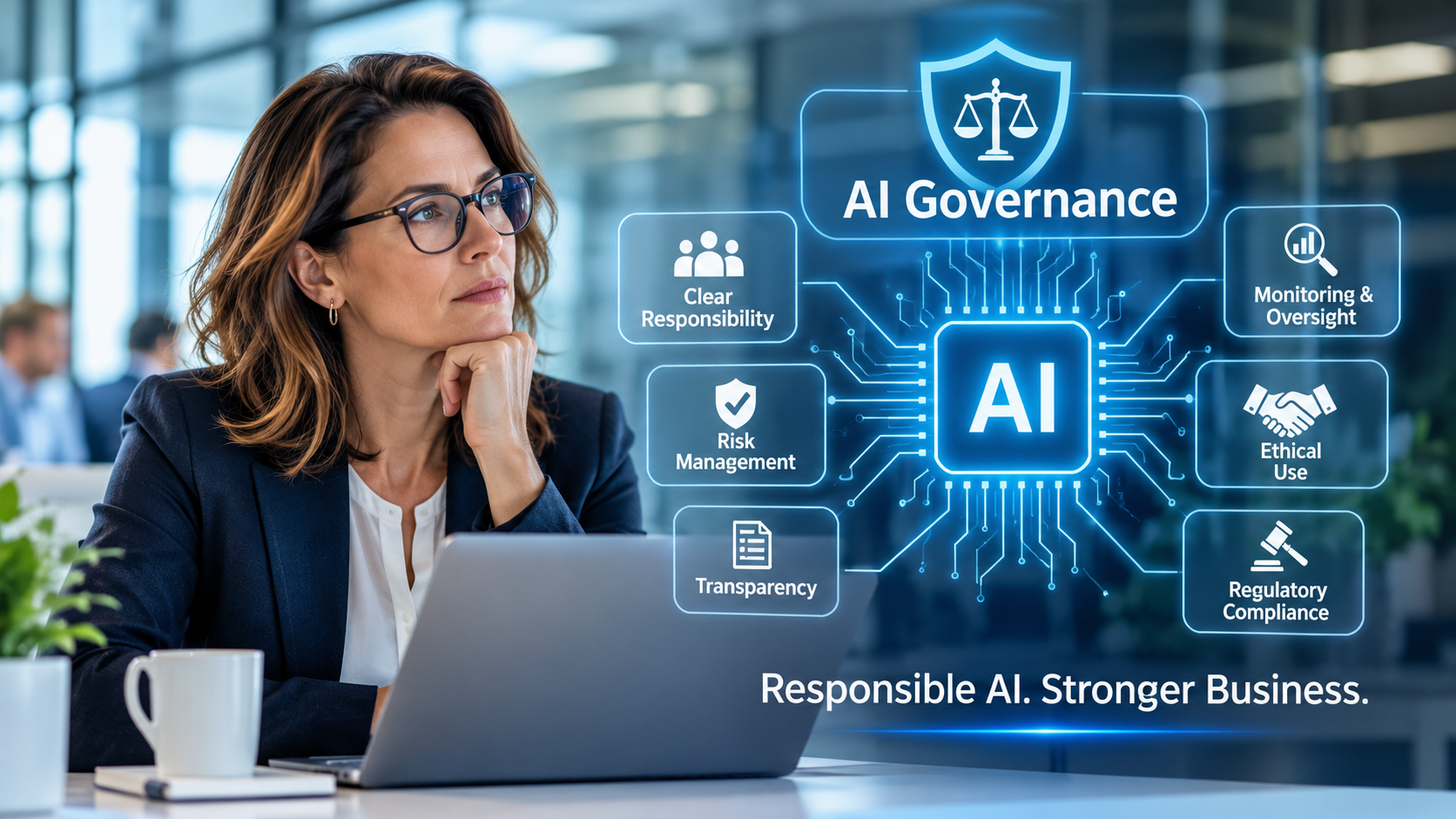
AI Governance for Businesses: Who Is Responsible When AI Makes a Decision?
Artificial Intelligence is no longer something businesses are only experimenting with. It is already helping companies handle customer enquiries, review applications, analyse financial information and automate everyday tasks.
For many organisations, these tools are making work faster and helping teams make better-informed decisions. But there is another side to this growing use of Artificial Intelligence that businesses cannot afford to overlook.
What happens when Artificial Intelligence (AI) gets something wrong?
Imagine a company using an AI-powered recruitment tool. It reviews hundreds of applications and shortlists candidates based on their experience and qualifications. The hiring team trusts the results, but later discovers that the system has been consistently overlooking suitable applicants because of patterns in its historical data.
Who is responsible? The software provider? The people who developed the system? The HR team that relied on its recommendations? Or the business that introduced it?
Questions like these are becoming increasingly important as AI takes on a bigger role in business operations.
This is where AI governance comes in. It helps businesses understand how AI should be used, who is responsible for its outcomes and what needs to happen when something goes wrong.
What Is AI Governance and Why Should Businesses Care?
AI governance is simply about setting the right rules and responsibilities for using artificial intelligence within an organisation.
Think about how a business manages its finances, customer information or workplace security. There are usually policies explaining who can access information, who approves important decisions and what happens when a problem occurs.
AI needs the same level of attention.
A business might use one AI tool to respond to customer enquiries, another to analyse sales data and a third to help its HR team review applications. Without clear guidelines, employees may use these tools differently, share information they should not or rely on results without checking their accuracy.
AI governance helps bring some structure to this activity.
It establishes:
- Which AI tools employees are allowed to use.
- What business information can be shared with these tools.
- Who is responsible for managing each AI application.
- When a person needs to review an AI-generated decision.
- How the business handles inaccurate or unexpected results.
- How AI systems are monitored over time.
The idea is not to make AI adoption more complicated. It is to make sure businesses know what they are using, why they are using it and what responsibilities come with it.
Why Is AI Governance Becoming Important?
Many businesses are adopting AI because they want to save time, reduce manual work and improve efficiency. However, introducing a tool is one thing; managing its impact on everyday business operations is another.
Here are some situations where a lack of proper governance can create problems.
1. AI Does Not Always Get Things Right
AI systems can analyse large amounts of information and identify patterns, but that does not mean every result is accurate.
For example, an AI-powered loan assessment tool may recommend rejecting an application based on information from previous lending decisions. If the historical data contains unfair patterns, those patterns may influence the new recommendations.
The system might be working as designed, but the result could still be unfair.
Businesses need to check the information their AI systems use, understand how they produce results and regularly review their performance.
2. Employees May Accidentally Expose Business Information
AI tools are now easy to access. Employees may use them to summarise documents, prepare reports or find solutions to everyday problems.
But what happens when someone uploads a confidential customer document or an internal financial report to an AI platform that has not been approved by the company?
The employee may simply be trying to save time, but the business could face an information security or privacy issue.
This is why organisations need clear guidelines about which tools can be used and what information employees are allowed to share.
3. Businesses Must Understand Their Legal Responsibilities
AI regulations are developing as governments try to address concerns around privacy, transparency, discrimination and automated decision-making.
The European Union’s AI Act is one important example. It introduces different requirements depending on the risks associated with an AI system and the role an organisation plays.
Businesses operating in international markets need to understand which regulations apply to them rather than assuming that using an AI tool is automatically compliant.
4. A Poor AI Decision Can Damage Customer Trust
Consider a customer who applies for a service and receives an automated rejection. The decision is incorrect, but the company cannot explain why it happened or provide a way to review it.
From the customer’s perspective, the problem is not just the technology. It is the way the business has handled the situation.
Customers expect businesses to take responsibility when something goes wrong. AI should not become an excuse for avoiding that responsibility.
Who Is Responsible When AI Makes a Wrong Decision?
This is probably the most important question businesses need to address.
There is no single answer for every situation. Responsibility depends on who developed the AI system, who supplied it, how it was configured and how the organisation uses its results.
However, businesses should never assume that responsibility disappears simply because a decision was made by AI.
Let’s look at the people and teams involved.
1. Business Owners and Senior Management
The responsibility for introducing AI into business operations starts at the organisational level.
Management needs to understand why an AI solution is being introduced, what risks it may create and whether the business is prepared to manage those risks.
For example, before introducing an AI system to assess customer applications, management should make sure that the technology has been properly evaluated and that there is a process for reviewing questionable decisions.
It is also important to establish who can approve new AI tools and who is responsible for monitoring their use.
2. IT and Technology Teams
IT teams play an important role in making sure AI systems work safely within the existing technology environment.
Their work may involve checking software security, managing access permissions, protecting business data and ensuring that AI applications connect properly with other systems.
For instance, if a company connects an AI chatbot to its customer database, the chatbot should only have access to the information it needs.
Without these controls, even a useful AI application could introduce unnecessary security risks.
3. AI Developers and Technology Providers
The companies that build and supply AI systems also have responsibilities.
They need to consider how their systems are designed, tested and maintained. They should provide relevant information about their products, including known limitations and appropriate usage.
However, purchasing an AI solution does not automatically transfer every responsibility to the software provider.
A tool may work well in one environment but produce unreliable results when introduced into a different business process or used with different information.
4. Employees Who Use AI
Employees are often the people interacting with AI systems every day.
They need to understand that AI-generated answers and recommendations should not always be accepted without checking.
For example, an employee using AI to prepare a financial report should verify important figures before sending it to management. Similarly, a customer service employee should know when an AI-generated response needs human attention.
Businesses should provide practical training so employees understand both the benefits and limitations of the tools they use.
5. Legal, Compliance and Risk Teams
When AI is used in areas such as recruitment, finance or healthcare, there may be additional legal and compliance considerations.
These teams can help assess privacy requirements, contractual responsibilities, regulatory obligations and potential risks.
Their involvement helps businesses identify problems before an AI application becomes part of a critical business process.
A Realistic Business Example: When an AI System Rejects a Customer Complaint
Let’s take a simple example.
A company introduces an AI-powered customer support system to manage a growing number of complaints. The system reads incoming messages, categorises them and decides which complaints need further attention.
One day, a genuine customer complaint is incorrectly marked as invalid. The system automatically sends a rejection message without involving a customer service employee.
The customer becomes frustrated and contacts the company again.
What went wrong?
Perhaps the AI misunderstood the customer’s message. Maybe the system was trained using incomplete examples. It is also possible that the company configured the system without providing an option for human review.
The problem could have started at several different points.
But the business still needs to take action. Someone should investigate the decision, contact the affected customer and correct the process.
This is exactly why AI governance matters. It ensures that businesses have clear responsibilities and a way to deal with problems instead of simply blaming the technology.
7 Things Businesses Should Include in Their AI Governance Framework
AI governance does not have to begin with a complicated policy document or a dedicated department. Businesses can start with a few practical steps and improve their approach as they introduce more AI solutions.
1. Decide Which AI Tools Employees Can Use
Not every AI application is suitable for business use.
Organisations should maintain a list of approved tools and explain what employees can use them for. They should also make it clear which applications are not permitted.
2. Know Who Is Responsible for Each AI System
Every AI application should have an identifiable owner.
This person or team should understand the system’s purpose, monitor its performance and make sure that the necessary checks are being carried out.
3. Check the Risks Before Introducing AI
Before implementing an AI solution, businesses should consider what could go wrong.
Could it expose sensitive information? Could it produce unfair results? Could an incorrect recommendation affect a customer’s finances or an employee’s career?
The level of checking should depend on the potential impact of the system.
4. Keep People Involved in Important Decisions
AI can help people make decisions, but businesses should carefully consider where human review is necessary.
For example, an AI system may help shortlist job applicants, but important recruitment decisions should have appropriate human oversight.
A person reviewing an AI recommendation should have enough information and authority to question or override it.
5. Keep Records of How AI Is Used
Businesses should document which AI systems they use, what they are designed to do and who manages them.
These records make it easier to understand how a decision was reached and investigate problems when they occur.
6. Review AI Performance Regularly
An AI tool that performs well today may not produce the same results as business requirements and data change.
Regular reviews can help identify inaccurate outputs, unexpected behaviour and changes in system performance.
7. Have a Plan for When Something Goes Wrong
No technology is completely free from problems.
Businesses should know who to contact, how to investigate an AI-related incident and when to suspend or restrict a system.
There should also be a clear process for correcting decisions and supporting anyone affected by them.
AI Governance Frameworks Businesses Should Know About
Businesses do not need to create every AI governance process from the beginning. Several established frameworks and standards can help them develop a structured approach.
Here are three worth understanding.
NIST AI Risk Management Framework (AI RMF)
Developed by the US National Institute of Standards and Technology, this framework helps organisations identify and manage risks associated with AI.
It is built around four functions: Govern, Map, Measure and Manage. These cover everything from establishing responsibilities to assessing risks and taking corrective action.
ISO/IEC 42001:2023
ISO/IEC 42001 is an international standard for Artificial Intelligence Management Systems.
It provides organisations with a structured way to establish, implement and continually improve their AI management practices.
Businesses looking to introduce AI more systematically may find this standard particularly useful.
European Union AI Act
The EU AI Act introduces a risk-based approach to regulating artificial intelligence.
It places different requirements on AI providers and organisations that deploy AI systems. Depending on the system and the organisation’s role, these can include risk management, transparency and human oversight.
Businesses should check the relevant implementation dates and determine which requirements apply to their activities.
It is worth remembering that these three approaches serve different purposes. NIST provides voluntary risk management guidance, ISO/IEC 42001 is a management system standard, and the EU AI Act is legislation.
How Can a Business Get Started With AI Governance?
For many businesses, the first challenge is understanding how much AI is already being used across different departments.
A practical starting point is to review existing tools and identify where they are involved in business operations.
Here is a simple approach:
Step 1: Make a list of AI tools currently in use.
Include tools used by marketing, finance, HR, customer service, IT and other departments.
Step 2: Understand what each tool does.
Identify the information it uses, the tasks it performs and whether its output influences important decisions.
Step 3: Identify potential risks.
Pay particular attention to customer information, employee records, financial data and decisions that could affect individuals.
Step 4: Assign responsibility.
Make sure someone is responsible for each AI application and knows when to involve IT, management or compliance teams.
Step 5: Set clear usage guidelines.
Explain which tools employees can use, what information they can share and when AI-generated results need to be checked.
Step 6: Train employees.
Help employees understand that AI is a support tool, not an automatic replacement for professional judgement.
Step 7: Review the process regularly.
As new tools and business requirements emerge, update the policies and controls accordingly.
Starting small is perfectly reasonable. What matters is having a clear approach and improving it as AI becomes more involved in business operations.
The Future of AI in Business Needs More Than Technology
AI will continue to change how businesses work. Tasks that once took hours may become automated, customer interactions may become faster and teams will have access to information that helps them make better decisions.
But adopting new technology is only part of the journey.
Businesses also need to think about the information they share, the decisions they automate and the people affected by those decisions.
A well-planned AI governance framework helps bring these responsibilities together. It gives employees clear guidelines, helps management understand potential risks and makes it easier to address problems when they occur.
The goal is not to slow down AI adoption or prevent businesses from exploring new opportunities. It is to make sure that innovation happens responsibly.
AI can analyse information, make recommendations and automate tasks. But the responsibility for how those capabilities are used still belongs to people and the organisations behind them.
How Chrysalis Can Help Businesses Move Towards Responsible AI Adoption
Introducing AI into a business is not just about finding a tool and putting it to work. It starts with understanding how the business operates, where improvements are needed and which technologies can make a meaningful difference.
At Chrysalis, we help businesses explore AI consulting, IT consulting, digital transformation and technology integration to support their changing operational needs.
Whether an organisation is exploring AI automation or looking to improve its existing technology infrastructure, the right approach starts with understanding its business requirements.
Responsible AI adoption means choosing the right solutions, understanding their limitations and ensuring that technology works alongside people and business processes.
Thinking about introducing AI into your business?
Explore how Chrysaliss can support your digital transformation journey.
Frequently Asked Questions About AI Governance
1. What is AI governance in business?
AI governance is a set of policies and processes that helps businesses use artificial intelligence responsibly and manage its risks.
2. Who is responsible when AI makes a wrong decision?
Responsibility depends on the circumstances, but businesses must ensure appropriate oversight and take corrective action when their AI systems cause problems.
3. Why is AI governance important for businesses?
It helps organisations manage risks related to data privacy, security, inaccurate results, bias and regulatory compliance.
4. Does every business need AI governance?
Any business using AI can benefit from governance policies, with controls suited to the risks and impact of its AI applications.
5. What is the difference between AI governance and AI ethics?
AI ethics defines principles for responsible AI use, while AI governance puts those principles into practice through policies, responsibilities and controls.
6. What are the main AI governance frameworks?
Commonly used references include the NIST AI Risk Management Framework, ISO/IEC 42001 and the EU AI Act.
7. Can AI make business decisions without human involvement?
AI can automate certain decisions, but businesses should determine when human review is necessary based on the potential impact and applicable regulations.
8. How can small businesses start with AI governance?
They can begin by listing their AI tools, setting usage policies, protecting business data and assigning responsibility for each application.